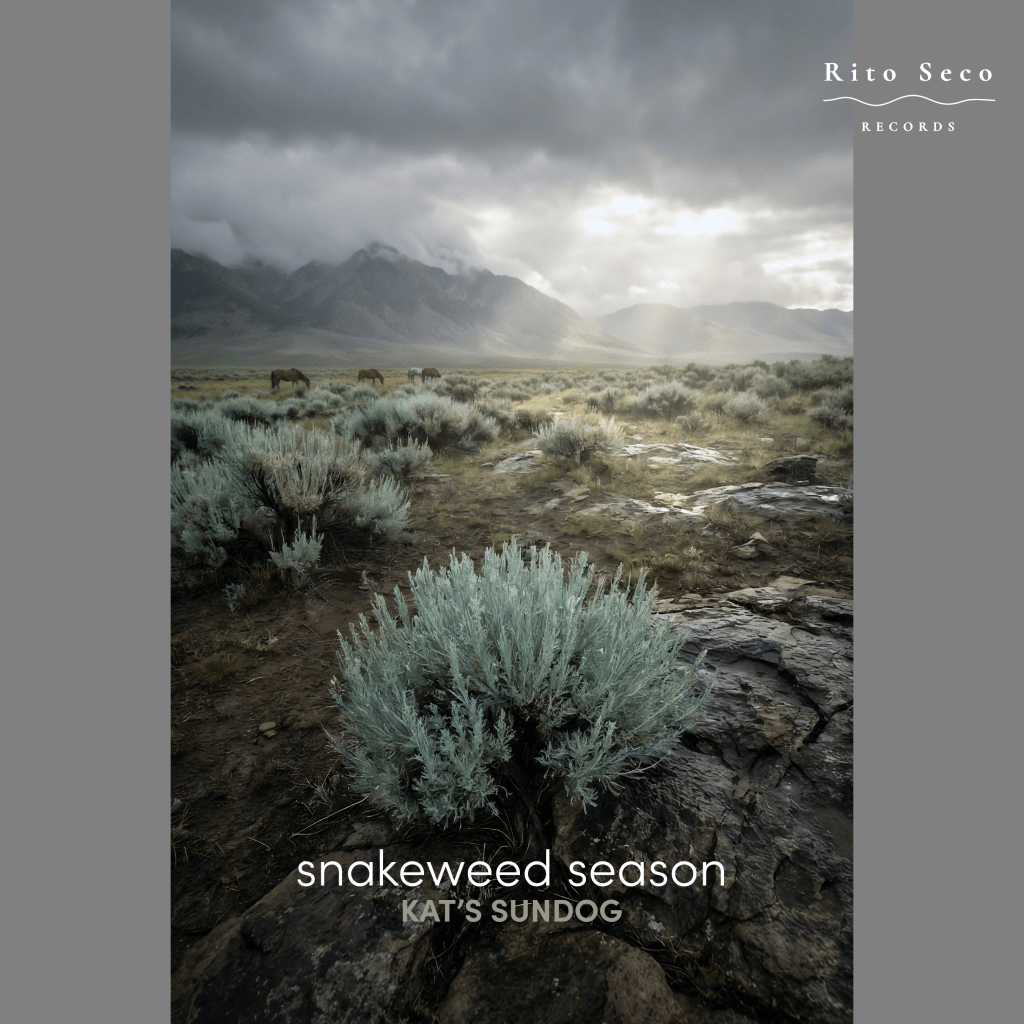
New from Kat’s Sundog (Rito Seco Records)
In Season: Place & Poetry in Snakeweed Season by Kat’s Sundog
Reviewed by Dr. Nora Ballantyne
High Lonesome: A Journal of American Roots Music, Vol. 14
Let me say at the outset what this review is not going to do. It is not going to spend its first five paragraphs establishing the reviewer’s credentials for skepticism before grudgingly conceding that the music is listenable. That has become the default posture for writing about AI-assisted music in 2025 and 2026, and it has produced a body of criticism that tells us more about the anxieties of critics than about the music being reviewed.
Snakeweed Season, the debut album from Kat’s Sundog on Rito Seco Records, deserves better than to be processed as a test case. It deserves to be heard first. So that is where we will start.
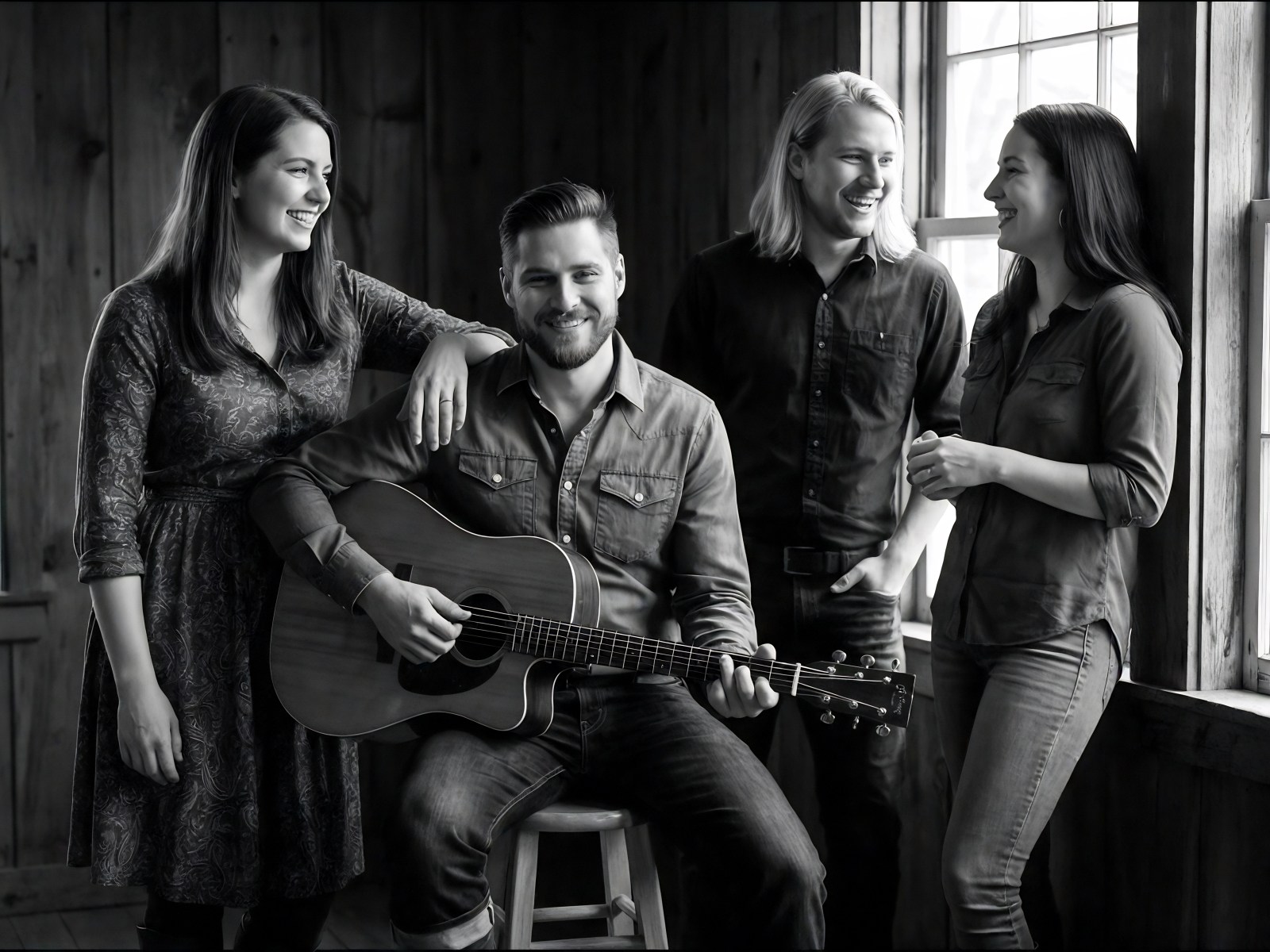
Kat’s Sundog is an Asheville-based quartet built around the voice and fiddle of Elara Vance, whose instrument in her hands sounds channeled rather than simply played — the instrument in this case was waiting for its partner. Alongside her, Selah Vance anchors the sound on mountain dulcimer with an archival authority that never tips into museum-piece solemnity.
Caleb Finnegan’s upright bass provides what good bass always provides in this tradition: gravity without weight, forward motion and not a metronome.
And Jonah Briggs operates throughout the album as what the best recording engineers call a space architect — filling exactly what needs filling, leaving alone everything that doesn’t. His acoustic guitar is almost worth the attention he himself gave to his childhood heroes. Worth study, in fact.
The band was recorded at Sycamore Sound in Nashville by engineer Raymond Puckett. The room’s sound is intimate without being claustrophobic, warm without the period-costuming that afflicts so much contemporary roots recording.
The fifteen songs on Snakeweed Season are adapted from a poetry collection of the same name, a manuscript of Western American verse about landscape, labor, devotion, and what the high desert does to a person’s sense of time. That’s the music’s architecture: it’s not incidental to it. Songs like “Santero” and “Keepin’ It Simple” still compress their images in a purely literary way. They were written as poems before they were lyrics, and that tectonic pressure produces stories instead of ditties, lapidary work, not cut glass.
They say more in less space; they trust the listener more completely. They also avoid the obvious tropes that flatten so much of what gets called Americana into something closer to wallpaper. “Santero” — the album’s closing track and its emotional center of gravity — achieves what the best Appalachian songs have always achieved: it makes the particular feel universal, without sacrificing the human detail that made it matter in the first place. The song ends, you sit with it, you play it again. Listeners have played the track on popular music platforms ten times as often as any other on the album. It moves with a slow, meditative beauty across a landscape we are never completely sure is a battlefield or an Eden — like our own country. It doesn’t have a hook. It simply holds you.
Listen: Santero
“Sugar Beets,” by contrast, is the album’s most outwardly accessible moment — a plains-country narrative with a melody that hits like something you already knew, which is the highest compliment one can pay to a song in this tradition. It is, in the best sense, a song about work: the sugar beet harvest of the high Colorado basin, rendered without sentiment and therefore, paradoxically, with great feeling. Selah Vance’s vocal on this track is the performance of the album, on an album of strong vocal performances.
Now. The question that hangs over this record in 2026, and which I would be professionally irresponsible to ignore: Snakeweed Season was produced with the assistance of AI tools. Rito Seco Records has been transparent about this. The question I want to put to the reader — and to the increasingly loud chorus of critics who treat this disclosure as a terminus rather than a beginning — is this: transparent about what, exactly?
The Americana tradition has never been what its mythology claims. The “authentic” mountain ballad was shaped by commercial recording in the 1920s, by the editorial decisions of folklorists with their own agendas, by the radio broadcasts that moved styles across regions faster than any oral tradition could. Doc Watson’s flatpicking, which Jonah Briggs clearly has studied at the cellular level, was itself a synthesis — old-time fiddle tunes translated into a guitar idiom that Watson partly invented and partly absorbed from a network of players the history books have not fully recovered.
The Carter Family’s “traditional” sound was the product of specific microphone placement choices made in a Bristol, Tennessee hotel room in 1927. Technology and tradition have never been separable in this music — or any other. The belief that they are is itself a product of the 1960s folk revival, which needed a usable past and constructed one.
None of this is to say that all production choices are equivalent, or that the question of AI in music-making doesn’t present challenges worth serious discussion. It is to say that the question is not — has never been — was a tool used? The question is what the tool was in service of, who was making the decisions, and what the decisions cost.
In the case of Snakeweed Season, what the AI tools were in service of was a body of literature. Storytelling. Real poems, written over fourteen months by a poet working at the intersection of the natural world and the written word, concerned with a specific landscape and what that landscape asks of the people who live in it.
The AI was not the source. It was one instrument in a larger ensemble of choices — choices about which poems to adapt, which melodic instincts to follow and which to override, how to mix and master the resulting tracks, what visual world and biographical mythology to build around the band, what voice to speak in.
That ensemble of choices constitutes authorship, not a diminished form of authorship. The American songbook has always involved tools, collaboration, and the productive tension between what a creator intends and what the medium will do.
What Kat’s Sundog and Rito Seco Records have built is not an AI product. It is a fully realized artistic object — one that began in language, moved through a composition process that involved both human and machine intelligence, and arrived at something that can move a room of people who have never heard it before and leave them wanting to hear it again.
That’s the test. That has always been the test.
The critics who are currently treating AI involvement as a binary disqualifier are, I would argue, doing something more damaging than they intend. They are ignoring the most important element — that craft, intention, and literary seriousness are what determine whether music matters. They abandon those important virtues because the music world is awash in hollow, algorithmically optimized content with no stake in any of those things.
They are making it harder, not easier, to draw a vital distinction that needs drawing: between music made with AI as a shortcut to product, and music made with AI as one moment in a longer human process that began somewhere authentic and ended somewhere worth going.
Snakeweed Season ends somewhere worth going. I recommend the journey.
Dr. Nora Ballantyne is Associate Professor of American Music Studies at the University of Virginia and a contributing editor of High Lonesome. Her most recent book, Borrowed Mountain: Commercial Recording and the Invention of Appalachian Tradition, was published by UVA Press in 2023.


Leave a comment