Broadcast Transcript — Approximate Runtime: 14 minutes
American Meridian is a weekly primetime newsmagazine broadcast on PBS, known for its longform cultural and investigative profiles. Now in its nineteenth season, the program draws an average of four million viewers and is produced in association with WBRD Asheville.
“A Long Way From Anywhere”
Correspondent Kate Severance on Kat’s Sundog
Kate Severance has covered American cultural stories for American Meridian since 2019, following twenty years at NPR. She is the recipient of three Peabody Awards and the author of The Listening Country: Music and Memory in Rural America (2022, University of Chicago Press). She lives in Montpelier, Vermont.
[OPEN — AERIAL FOOTAGE: The San Luis Valley, Colorado. High desert flatlands ringed by snow-capped peaks. A hawk circling. The shadow of clouds moving across sagebrush flats. Then cut to:]
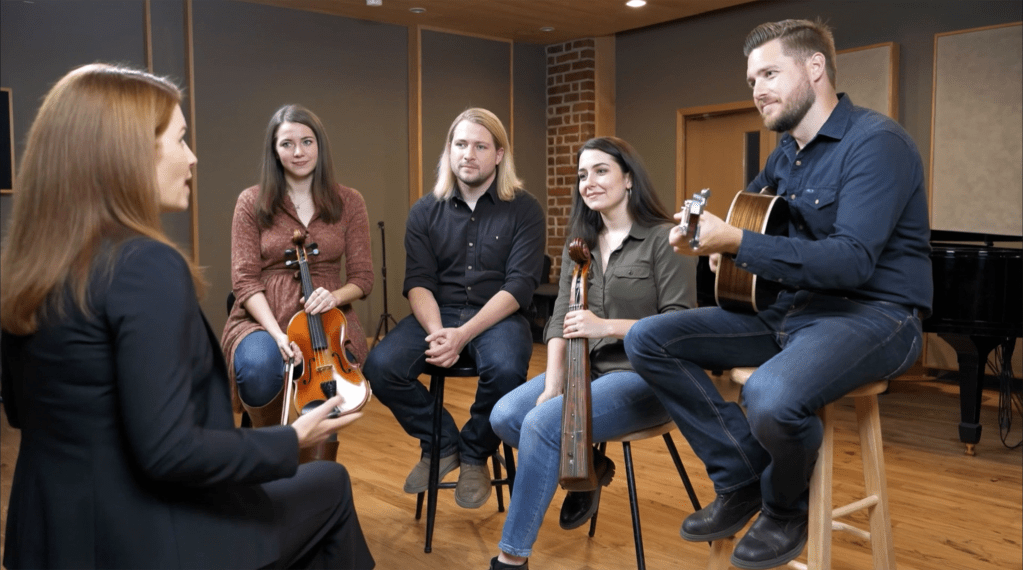
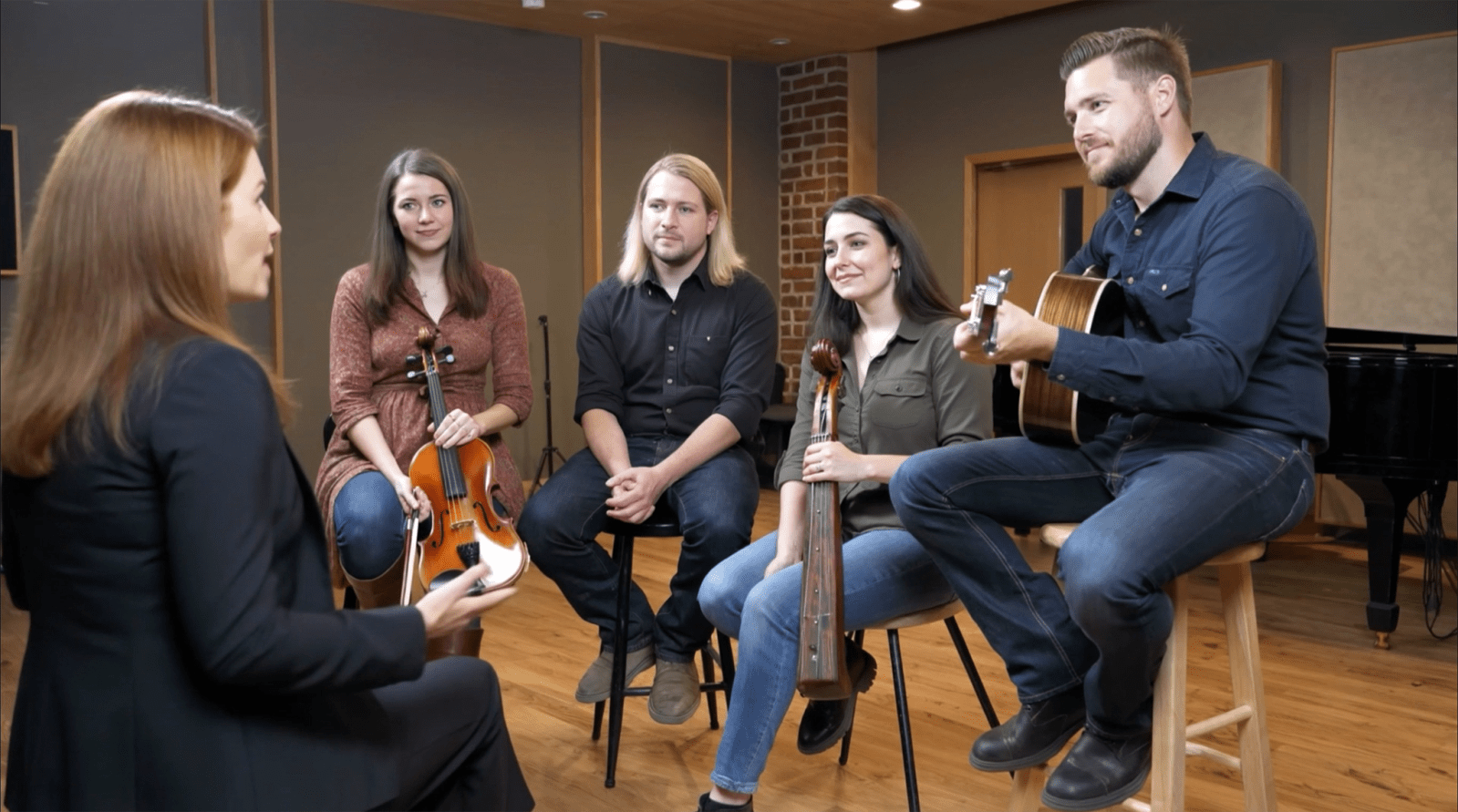
[INT. SYCAMORE SOUND RECORDING STUDIO, NASHVILLE. The four members of Kat’s Sundog are seated in a rough arc in the live room — the same room where the album was made. Elara Vance has her fiddle across her knees. Jonah Briggs is turned slightly in his chair, one boot resting on his knee. During the interview he picks up his guitar and plays a few bars. Cal Finnegan sits with his hands relaxed in his lap. Selah Vance sits slightly back from the others. Kate Severance faces them.]
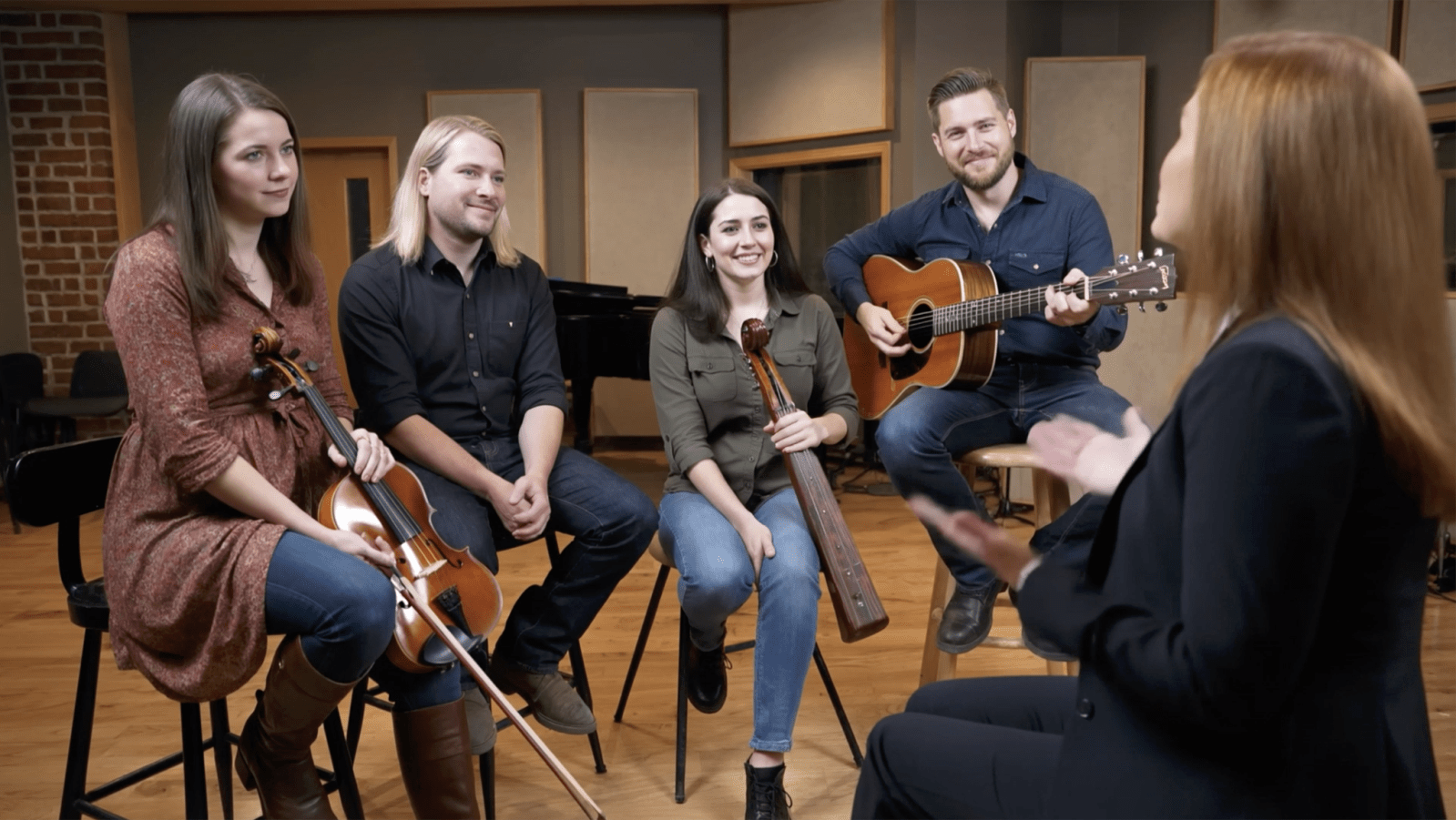
SEVERANCE VO: In a music industry that increasingly rewards the instant and the disposable, Kat’s Sundog arrived this spring from what felt like a different century. Their debut album, Snakeweed Season, has spent six weeks on the Americana charts, earned three Grammy nominations, and produced one song — “Keepin’ It Simple” — that has been streamed over twenty-four million times. None of that was the plan. The plan, as far as there was one, was to make a record that sounded authentic, that came from somewhere real. The question of exactly where that somewhere is, turns out to be more complicated than might first appear.
SEVERANCE: (to the group) When I listen to this album, the word I keep coming back to is old. It sounds old. Is that a compliment?
ELARA: (laughs) From you? Yes.
JONAH: We’d take it either way.
SEVERANCE: Where does that quality come from?
SELAH: The source material, partly. The poems the album adapted were written in Colorado, in the high desert of the San Luis Valley, by someone who is deeply aware of time — geological time, ecological time. That… quality comes through.
SEVERANCE: And the rest?
CAL: The room. (gestures around him) This room has plaster walls from 1943. You can’t fake what a room like this does to sound.
SEVERANCE VO: The room is Sycamore Sound, a converted Victorian house on Fatherland Street in East Nashville, owned and operated by engineer Raymond Puckett — known universally as Puck — who has been making records here since 1993. His client list spans bluegrass, gospel, and three Billboard country charting albums. He isn’t easily impressed.
[CUT TO: INT. SYCAMORE SOUND CONTROL ROOM. Puck is at the Neve board, a coffee in hand, surveying the room with the equanimity of someone who has spent thirty years listening at high volume in small spaces.]
PUCK: The thing about this band is they knew what they wanted before they walked in. That’s rarer than it sounds. Most acts come in and they’re still figuring it out at the board, which costs everyone time and money. These four — they’d done the work. Selah especially. She had the arrangements so deep in her body that the sessions ran almost like a live record. We’d do two, three takes. Jonah would pull me aside and say, take two. And take two was always right.
SEVERANCE: (to Puck) What surprised you?
PUCK: (pause) Dell. I’ve known Dell Rodgers for twenty years. Good guy, rough time lately. When Jonah brought him in I thought — okay, this is a favor, we might get something usable. (shakes head) Dell walked in, looked at the lyric sheet for “Line Crew”, and just — went somewhere. We didn’t do two takes. We did one.
[CUT BACK TO: LIVE ROOM. The four band members.]
SEVERANCE: Dell Rodgers. He appears on three tracks, and the response to his performance has been almost as significant as the response to the band itself. Jonah, you brought him in. How did that happen?
JONAH: I’d done a session with Dell about a year before we recorded this album. Background guitar on something I won’t name. And the session was fine, the track was fine, but I kept watching Dell between takes and thinking — that’s a voice that’s not being used right. There’s something in there that’s not getting out. And when I read “Line Crew” for the first time, I heard his voice on it immediately.
SEVERANCE: He’s had a difficult road.
JONAH: He has. And I think that’s in the performance. You can’t manufacture what Dell does on that track. It comes from somewhere …hard-won.
SEVERANCE: (to Elara) You wrote that song. What is it like to hear someone else’s voice carrying it?
ELARA: (quietly) It’s right. When you write a song and it finds its voice, you know. There’s no ambiguity. Dell found that song. I just (gestures) put down breadcrumbs.
SEVERANCE VO: The songs on Snakeweed Season are adapted from a poetry collection of the same name by Colorado poet Kat Couch — it’s a pen name, chosen with equal parts seriousness and humor for reasons the band declines to fully explain. The poems were written on an off-grid mesa in the southern San Luis Valley, eighty-five hundred feet above sea level. The poet and the band have never been in the same room.
SEVERANCE: That seems unusual. A band builds an entire album around someone’s work and they’ve never met.
CAL: We’ve emailed. Texted. Kat gave us permission without any conditions, which felt like an enormous act of trust. We don’t take that lightly.
SEVERANCE: Or an enormous act of indifference?
CAL: (smiles) I don’t think so. The questions Kat asked — when they came up — were very specific. About tempo. About whether an image survived the adaptation. That’s not indifference. That’s someone who trusts but is paying attention.
SEVERANCE: Selah, you’re the musical historian of the group. You’ve spent almost fifteen years in a music archive. When you read these poems for the first time, what did you recognize in them?
SELAH: The modal quality, technically. The flatted intervals, the unresolved cadences — they’re written by someone who has absorbed a lot of old music without necessarily knowing that’s what they’ve absorbed. And underneath the technique, I recognized the condition. Someone in the early hours trying to organize their experience of the world into something that holds… makes sense. That’s what folk music has always been for.
SEVERANCE: Is that what it’s been for you?
SELAH: (pause) I’ve spent all this time in the State archive. Learning to honor other people’s music, to understand where it came from and why it mattered. And somewhere in that work I was also — (stops, recalibrates) — I think the archive was a way of being close to something I hadn’t found my own way into yet. These poems gave me a way in.
[A brief silence. Elara looks at her stepsister with an expression the camera catches. It is hard to read.]
SEVERANCE: Elara, the album opens with your voice on “Keepin’ It Simple” and closes with Jonah’s on “Santero”. Was that deliberate?
ELARA: (considers) The track order was deliberate. It just seemed to work — I don’t know that there’s anything more to it than that.
SEVERANCE: But it works because…?
JONAH: (to Elara) All yours.
ELARA: (to Jonah, amused) Thank you so much. (to Severance) The album tells a story. Not a linear one — it moves through grief and humor and memory and back again. But it begins with someone trying to make sense of things and ends with someone who has stopped needing to. That felt right as an arc. Jonah’s voice at the end carries a quality of — acceptance, right? My song, like, asks a question. His makes peace with it.
SEVERANCE: Jonah, is that how you think of it?
JONAH: I think of it in a technical way, I guess. Selah’s dulcimer, the drone underneath everything. The song starts with that — just the drone, for almost fifteen seconds, before I sing a word.
SEVERANCE: (to Selah) How does it feel to know your instrument is the thing the listener hears beneath the final song?
SELAH: (smiles) I’ll take it. It — you know, it puts the work in a traditional place.
SEVERANCE VO: The band’s label, Rito Seco Records, is their own creation — named for the dry creek beds of the San Luis Valley, present in the landscape but not always running. It is, they say, a label that exists when the music asks it to. The debut album has asked loudly enough that a second record is already in conversation. The terms of that conversation, it turns out, were negotiated before the first one was finished.
[CUT TO: EXT. OUTSIDE SYCAMORE SOUND. Cal and Jonah lean against the building in the late afternoon light.]
SEVERANCE: Cal, you recorded one track — “Wolf Sanctuary” — alone in your workshop in Asheville. Why?
CAL: The poem it comes from is about someone who died. A friend who mattered. It isn’t a song that needed a studio. It needed a room that had been lived in, where things had been made and broken and fixed.
SEVERANCE: Ah, right. You build instruments, don’t you?
CAL: I do.
SEVERANCE: Including instruments the band plays.
CAL: Some of them.
SEVERANCE: You built Jonah’s guitar.
CAL: (glances at Jonah) I did. One guitar. He still mostly plays Martins.
SEVERANCE: Jonah, what was that like? Being handed an instrument built by someone who knew your playing that well?
JONAH: (pause) I haven’t found the right way to thank him yet.
CAL: You don’t need to…
JONAH: (to Severance) That’s Cal, by the way. That’s exactly Cal.
Listen: Wolf Sanctuary
[[CUT BACK TO: LIVE ROOM. All four together.]
SEVERANCE: I want to ask about the future. The second album. I’ve heard the word “traditional” used… What does that mean for this band?
ELARA: It means Selah picks the songs.
SELAH: It means we go back to the source. The Child Ballads, the Sacred Harp tradition, the recordings we’ve spent a lot of time with. The poems gave us the emotional language. The next record will be about the musical language behind it, the roots.
SEVERANCE: Jonah, you’re nodding. But you’re also the one who pushed this album in directions it might not have gone otherwise — Dell Rodgers, Rafael Santos, the Bakersfield track. Are you comfortable with a purely traditional record?
JONAH: Oh gosh, yeah. And I gave my word. (beat) I trust Selah’s instincts more than mine on this. She’s been right every time she pushed back. The production is mine and it’s good and it’s also — not always what the music needs. The music on the second album will be something else.
SELAH: (to Severance, quietly) He’ll listen for about forty-five minutes and then he’ll have an idea.
JONAH: That’s fair.
SEVERANCE: (to all four) Last question. The album title, the band name, the label name — they all point back to the same landscape. The Colorado high desert. A place none of you are from. Why does that place have such a hold on this project?
JONAH: (raises hand, laughs) I’m in the vicinity.
SEVERANCE: That’s right: you’re from Austin. Still…
[A pause. The four exchange looks.]
ELARA: Well, the poet is from there. And the poems are so specific to that place that when you inhabit them — when you really try to understand what they’re saying — you end up there. It’s about place.
CAL: The music we play comes from the mountains. Maybe it doesn’t matter which mountains. I’m not from North Carolina or Tennessee… but mountains have their own language. It… it travels well.
SELAH: (to Severance) There’s a line in the closing song “Santero”. The wind will mistake that wild shape for its own. The shape is a person, dissolving into the landscape they’ve inhabited a long time. That’s what this album is, in a way. Four musicians from different places, inhabiting someone else’s landscape long enough to make it sound like their own.
SEVERANCE: Does it work? Did it work, do you think?
SELAH: (looks at Elara, at Jonah, at Cal) Ask the twenty-four million people who streamed “Keepin’ It Simple”.
[Elara laughs. Cal smiles. Jonah looks out the window at the Nashville afternoon.]
SEVERANCE VO: Kat’s Sundog’s debut album Snakeweed Season is available now on Rito Seco Records. The poetry collection of the same name, by Kat Couch, is due out by September. A second Kat’s Sundog album is in early development.
[CLOSE — the dulcimer drone from the opening of “Santero”, fading up beneath the final credits.]
[END OF SEGMENT]
Produced by Marcus Osei for American Meridian, PBS News. Research: Yuki Tanaka. Camera: David Okonkwo, Renata Lourdes. © American Meridian / WBRD Asheville Broadcast date: [to be determined].
American Meridian is a fictional television newsmagazine created for the purposes of this narrative. Any resemblance to actual PBS programming is coincidental. All interviews, persons, and events depicted in connection with Kat’s Sundog are fictional.


Leave a comment